
How Much Does Trenchless Sewer Line Repair Cost?
Trenchless sewer line repair typically costs $4,000–$15,000 and offers a faster, less disruptive alternative to traditional excavation by fixing pi... Read More

Same-Day Service Available
Need a Plumber in Knoxville? We’re Ready to Help!




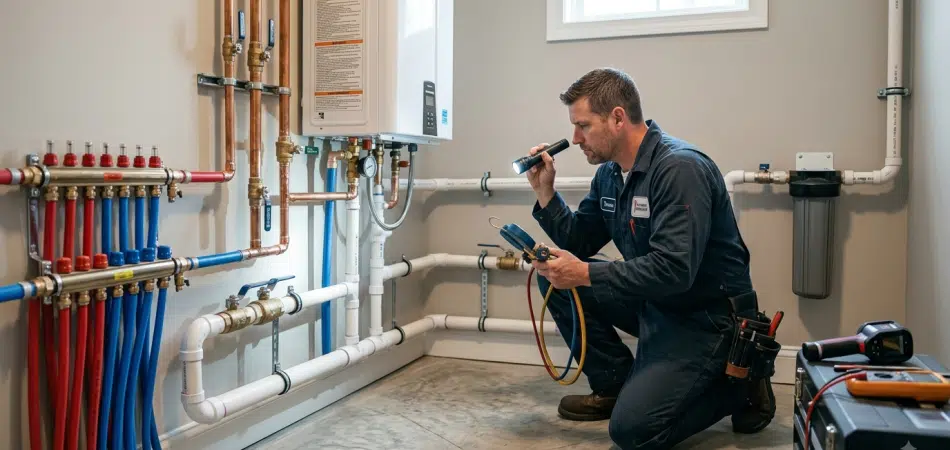
Newer subdivision homes and older Knox County homes may show different plumbing risks, but construction age does not determine the condition of an individual system. Older homes may contain galvanized steel, cast iron, copper, or clay components that can experience corrosion, scaling, joint deterioration, or root intrusion. Newer homes might have PEX, CPVC, PVC, copper, or polybutylene pipes. Common issues can include problems with fittings, connections, installation, wear and tear of materials, pressure, drainage, or hidden leaks. Most plumbing rules say that if water pressure is above 80 psi, you need an approved pressure-reducing valve. If a system has a pressure-reducing valve, check valve, or backflow preventer, it might also need to manage thermal expansion at a water heater.
There is a persistent assumption that a newer house means fewer plumbing problems. It means different plumbing problems. A 1998 subdivision home in Farragut and a 1948 bungalow in Fountain City may present different plumbing risks, although common problems such as clogs, fixture failures, leaks, water-pressure issues, and sewer-line defects can occur in homes of any age. Plumbing services across Knox County get sorted by construction era before anything else.
Tennessee Standard Plumbing has served customers across both residential and commercial needs for more than 13 years. With a 5.0 Google rating from over 1,000 reviews, HomeAdvisor Elite Service recognition, and a team of 50+ experienced technicians, the company provides trusted plumbing services throughout Farragut and the growing western Knox County communities it serves.
The sections below explain what has changed in materials, why pressure is a key issue in new buildings, what slab foundations hide, and what older homes suffer from instead.
Residential plumbing materials changed gradually and unevenly from the 1970s through the 1990s. Galvanized steel, copper, CPVC, PEX, cast iron, clay, and PVC can all be found in homes from overlapping construction periods. Each material has different strengths and failure modes, so the home’s actual pipe material and condition matter more than its construction year alone.
PEX is cross-linked polyethylene, flexible, and runs in long continuous lengths with far fewer joints than a rigid system needs. CPVC is a rigid chlorinated PVC joined with solvent cement. Neither corrodes, which eliminates the pinhole leaks and flow restriction that define older metallic systems. What remains are the connections: crimp rings, expansion fittings, and solvent joints, all of which depend on installation quality rather than material longevity. A newer home with a supply leak almost always has it at a fitting. How this plays out on the drain side is covered in this comparison of drain performance in older and newer homes.
Polybutylene was used in millions of U.S. homes, particularly from the late 1970s through the mid-1990s. Indoor pipes are usually gray, silver, or sometimes another color. Blue polybutylene was used for some underground service lines. However, color alone doesn’t tell you everything. Certain polybutylene systems with specified fittings were covered by the Cox v. Shell settlement involving installations from January 1, 1978, through July 31, 1995. The settlement resolved claims without the defendants admitting liability. Chlorinated water and other factors can cause damage and leaks. Therefore, a qualified inspector or plumber should check for suspected polybutylene. Homeowners should then check current insurance, resale, and replacement implications with their insurer and real-estate professionals.
Drain, waste, and vent systems moved from cast iron to PVC across the same period. PVC does not shrink or rust, so it stays the same size inside for a long time. This is why newer homes usually do not have the slow flow problems that older cast iron pipes have. The tradeoff is noise, since PVC transmits sound that cast iron mass absorbed, and rigidity at joints, where movement or poor support shows up as a separation rather than as a slow leak.
 Pressure is the defining variable in newer construction. Section P2903.3.1 of the International Residential Code requires a pressure-reducing valve where water supply pressure at the building exceeds 80 psi, set to deliver between 60 and 80 psi downstream. That single component, and what happens when it fails, accounts for a large share of newer-home service calls.
Distribution pressure changes with height and system design. Areas built on higher ground or connected to a main line designed for future growth may experience incoming pressure much higher than what homes require. The pressure reducing valve, installed on the building supply after the meter and before the first branch, brings it into range. It is a wear component with a diaphragm and a spring, not a permanent fixture, and it fails gradually rather than suddenly.
A failing regulator shows itself in a scatter of symptoms that rarely get connected. Faucets that spray, toilets that fill up loudly, a banging noise when a washing machine valve shuts, a water heater valve that releases water now and then, and supply lines that break early all show that the water pressure is too high. A static pressure gauge on a hose bib settles the question for a few dollars, and a reading above 80 psi points directly at the regulator. Where elevated pressure has already caused damage, pipe leak repair addresses the result while the regulator addresses the cause.
A pressure-reducing valve generally does not allow backflow toward the main, which makes the home’s plumbing a closed system. Water expands when heated, and in a closed system that expansion has nowhere to go, so pressure spikes each time the water heater runs. Code addresses this with a thermal expansion tank at the heater. Without one, the spikes are absorbed by the weakest components: the relief valve, fill valves, and supply connections. This is why a house can have a correctly functioning regulator and still show pressure symptoms if the expansion tank is missing or has lost its charge.
 Slab-on-grade is the dominant foundation in newer western Knox County construction, and it changes how plumbing problems present. Supply and drain lines routed beneath a concrete slab are inaccessible, which means failures are identified by symptom and instrument rather than by looking at the pipe.
In slab construction the drain system and often portions of the supply system run below or within the concrete before rising into walls. That routing is durable and entirely hidden. A leak in an under-slab supply line releases water into the fill beneath the floor, where it can travel laterally before any evidence reaches the surface. Detection relies on pressure isolation, acoustic equipment, and thermal imaging rather than inspection.
Signs of a leak show up after it has been happening for some time. You might feel a warm area on the floor if the leak is from hot water. You could see a part of the floor bending or changing color. Your water bill might go up without any clear reason, or you might hear water running even when all taps are off. Any one of those in a slab home warrants a static meter test rather than watchful waiting, because the cost curve on a slab leak is driven by duration.
Newer homes often put the water heater in a garage or a utility closet instead of a basement. This means the water tank is above or next to finished areas. A drain pan piped to an approved discharge point is what keeps a tank failure from becoming a flooring claim. Pans that were put in but never connected, or connected to a spot that is now hidden, are often found in homes that are fifteen to twenty-five years old.
Older housing across Fountain City, Bearden, North Knoxville, and unincorporated Knox County fails from material decay rather than from pressure. The systems were installed correctly for their era, and the materials have simply reached the end of their service lives. The failure modes are slow, progressive, and predictable.
Galvanized steel supply lines corrode from the inside once the zinc coating wears through, producing both particles in the water and progressive flow restriction. Early copper installations fail differently, with pinhole leaks appearing where water chemistry, velocity, or original workmanship concentrated wear. Both present as symptoms a newer home almost never shows: discolored water, weak pressure at upper floors, and leaks that appear in the middle of a pipe run rather than at a fitting.
Interior cast iron builds scale that catches solids and eventually channels along the bottom of the pipe. Exterior clay tile laterals fail at their joints, which is where roots enter. Neither problem exists in a PVC system, and both are routine in pre-1970 housing. This is the clearest single division between the two housing eras, since a newer home’s drain complaint is usually a blockage while an older home’s drain complaint is usually the pipe.
Older homes were plumbed to the codes and household patterns of their time, which means fewer fixtures, smaller supply mains, and venting arrangements that predate current requirements. Adding a second bathroom or a modern appliance load to that system can expose limits that were never a problem before. Renovating older homes often reveals problems with the systems in place. In contrast, renovating newer homes usually just involves adding to a system that already works well.
Knowing roughly when a house was built narrows a plumbing diagnosis faster than any other single fact. Our team at Tennessee Standard Plumbing works across both ends of Knox County’s housing stock, from Farragut subdivisions to prewar homes closer in, and the first question is almost always the year.
Four points are worth carrying. Newer homes fail at fittings and from pressure, not from corrosion. A static pressure gauge on a hose bib is the cheapest diagnostic available. A pressure-reducing valve indicates that the water heater requires effective thermal expansion control. Homes plumbed between 1978 and 1995 are worth checking for polybutylene.
Homeowners can reach our team at (865) 352-9003 or contact our team online. Peaceful Pipes, Peaceful Life.
We serve Farragut, Karns, Hardin Valley, and communities across Knox County and East Tennessee.
They have different ones. Modern PEX, CPVC, and PVC do not corrode, which removes the leading failure mode in older housing. What remains concentrates at fittings, appliance connections, and pressure-related components, so a newer home’s supply leak is almost always at a joint rather than mid-run.
Section P2903.3.1 of the International Residential Code requires one where water supply pressure at the building exceeds 80 psi. It is set to deliver between 60 and 80 psi downstream and installed on the building supply after the meter, before the first branch connection.
Attach a static pressure gauge to a hose bib and read it with nothing running. Above 80 psi points at the regulator. Supporting symptoms include faucets that spray, loud toilet refills, banging when an appliance valve closes, and a water heater relief valve that discharges periodically.
Because the valve generally prevents backflow toward the main, which makes the plumbing a closed system. Heated water expands and has nowhere to go, so pressure spikes every time the water heater runs. A thermal expansion tank absorbs that. Without one, the spikes are absorbed by relief valves, fill valves, and supply connections.
A plastic supply pipe, gray indoors and blue outdoors, installed in roughly 6 million homes between January 1978 and July 1995 using resin manufactured by Shell Oil. It was found defective in the Cox v. Shell class action, which settled in 1995, and production ended that year. Chlorine and other oxidants attack the interior, making the pipe brittle.
By instrument rather than inspection, since the pipe is inaccessible. Detection combines pressure isolation to determine which line is losing water with acoustic equipment and thermal imaging to locate it. A static meter test confirming continuous loss is the step that justifies bringing that equipment in.
A warm area on the floor when the leak is on the hot side, flooring that cups or discolors in one spot, an unexplained increase in a water bill, and the sound of running water with every fixture closed. Any of those in a slab home is worth a meter test rather than waiting.
Because newer homes often locate the heater in a garage or interior closet, next to or above finished space. A pan only protects anything if it is piped to an approved discharge point. Pans installed and never piped, or piped to a termination since covered over, are a routine finding in homes fifteen to twenty five years old.
They fail differently rather than one being categorically better. PEX runs in long continuous lengths with fewer joints and does not corrode or suffer pinhole leaks. Copper is rigid, tolerates higher temperatures, and has a longer track record. In either system, installation quality at connections is the variable that matters most.
Because PVC transmits sound that the mass of cast iron absorbed. It is a comfort difference rather than a defect, and it is most noticeable on a drain stack running through a wall next to living space. Insulating the stack during construction or renovation addresses it.


Trenchless sewer line repair typically costs $4,000–$15,000 and offers a faster, less disruptive alternative to traditional excavation by fixing pi... Read More

To install a kitchen sink drain, first remove the old one and clean the sink opening. Next, place plumber's putty under the new basket strainer's f... Read More

Hard water quietly shortens the life of dishwashers, washing machines, coffee makers, ice makers, and water heaters throughout Knoxville, leaving m... Read More